October 2024
Introduction
- The Restaurant Association of New Zealand (the Restaurant Association) welcomes the opportunity to make a submission on the work health and safety regulatory system.
- This submission is written on behalf of members of the Restaurant Association, who are predominantly restaurant and cafe owners in the hospitality industry. Our membership spans the length and breadth of the country, and have provided their views on the work health and safety regulatory system to help inform this submission.
- The feedback from our members was collected through an online survey. All respondent currently had a Health and Safety Programme in place at their businesses. The average ranking of the importance of health and safety policy at the respondent’s workplace was 78 out of 100, with the lowest ranking at 30 and the highest at 100.
- The Restaurant Association supports the development of a health and safety regulatory system that is easy to follow and low-cost for businesses, while retaining a high level of safety for employees. We agree with the Government’s sentiment that the health and safety system needs to be clear, sensible, proportionate, and effective, with steps taken to ensure employer approaches to health and safety are considered, appropriate and meaningful, rather than a tick-box exercise.
Focus area one: businesses are best placed to understand and manage their risks
5. The key actions our member businesses take to manage health and safety risks can be categorised into four areas; employee health and safety training, discussions about health and safety, maintaining equipment, and hazard reporting.
5.1. Members include a health and safety induction for employees to educate and encourage staff to manage health and safety risks.
5.2. Members stated they have regular discussions about health and safety during meetings, with some including external consultants and including wellbeing check-ins.
5.3. Members maintain and upkeep equipment to minimise the risk of incidents, with some also purchasing equipment such as non-slip mats to further minimise the risk.
5.4. Members have hazard identification and harm minimisation reporting processes to track near misses and accidents, with some using external software for these processes.
6. Most of our members think these key actions are reasonable, however, they also note that some enforced compliance measures can be laborious and time consuming – particularly for small business owner-operators. The hospitality industry is a fast-paced, challenging environment and our members recognise the importance of taking adequate actions to manage health and safety risks to both employees and customers.
7. These key actions are mostly effective in managing health and safety risks, although our members did highlight the need to also rely on employees and customers which can at times be unpredictable and create their own risks.
8. When asked how well their business understands its work health and safety obligations, around 94% of members chose ‘quite well’ or ‘very well’. The 6% of members that chose ‘not that well’ suggested that an industry-specific template or guide of work health and safety obligations would help them to better understand their obligations.
9. The cost to businesses per year to comply with their health and safety obligations varied largely, with most members paying between $5000 and $10,000 annually, but some paying upwards of $100,000 annually. This is likely due to the variance in size of our member organisations, with the majority in the hospitality industry being micro- or small-businesses. Those members who were unable to estimate their annual cost provided examples of spending to meet their obligations such as time spent on compliance measures, and health and safety equipment.
10. Most of our members spent between one to three hours per week on health and safety, however as with the variation in financial costs, there were some members that spent much less than that and some that spent as much as ten hours per week.
Focus area two: the law is designed to balance flexibility and certainty
11. When asked to provide examples of the requirements our members frequently engage with that are too detailed, strict or inflexible to allow businesses to comply, survey respondents provided the following comments:
“The downside of the HSWA is the catch-all “taking all practicable and reasonable steps to minimise harm” or words to the effect thereof. If something goes to court, a prosecutor simply needs to establish that one more practicable and reasonable step could have been taken and the defendant will be found guilty.”
“The reporting and logging of all information is [time consuming] and not suitable for small businesses.”
“The hazard register, identification and return to work policy.”
“That the employer is to blame even if the employee is at fault.”
“Some aspects of LPG and fire staff training and understanding.”
“Health and safety needs to be tailored to each industry, not be one model for all.”
12. When asked to provide examples of work health and safety law where there is not enough detail or too much ambiguity in law or regulations, survey respondents provided the following comments:
“The cost of paid consultants to help with compliance is way too high for small enterprises.”
“The importance of wellbeing and employee induction.”
“[The law] needs to be simplified and easy to follow. {There are] too many words and bullet points [should be used].”
“The increase in mental health complaints/issues is tricky to navigate.”
13. When asked to provide examples of work health and safety law where requirements are causing problems, survey respondents provided the following comments:
“The paperwork is a bureaucratic nightmare.”
“The hazard register and identification.”
“The workers duty.”
“Having the same compliance measures interpreted differently by different certifiers.”
“Nothing in particular, but having an element of fastidiousness as an owner is probably helpful in ensuring you don’t find yourself on the wrong side of the Act.”
14. When asked to provide examples of work health and safety law where requirements are working well, survey respondents provided the following comments:
“The Act does bring safety and health to the forefront of an owner’s mind. While this is a good thing, it probably occurs as something of an impost or fear of consequence than for any other reason.”
“Providing the opportunity for regular check ins with staff.”
“Problem solving risks is a good thing.”
“Incident reporting and wellbeing.”
“Using our own in house documents, systems and verbal reporting seems to work well for us.”
15. The top five sources of information or advice that our members use to help them understand their responsibilities under the law and how to comply ranked, in order of priority:
15.1. First, industry associations.
15.2. Second, third parties authorised by WorkSafe or the regulations (eg compliance certifiers or auditors).
15.3. Third equal, law or regulations, guidance, and health and safety advisors or consultants third equal.
15.4. Fourth, word of mouth.
15.5. Fifth, the regulator (i.e. WorkSafe).
16. The other sources of information or advice included social media, other countries best practices and common sense.
17. For each of the sources of information or advice that members use:
17.1. 64% of members agreed that the information or advice provides clarity about roles and responsibilities for health and safety in their workplace and on the actions necessary to keep people healthy and safe in their workplace
17.2. 57% of members agreed that the information or advice is relevant to their work.
17.3. 7% of members agreed that the information or advice is consistent across sources, easy to find, easy to understand, and easy to apply.
Focus area three: worker engagement and participation
18. When asked if their business or organisation has worker engagement and participation practice:
18.1. 88% had regular meetings where health and safety is discussed
18.2. 80% had a system for regular health and safety communications
18.3. 53% had elected health and safety representatives
18.4. 53% had regular health and safety briefings (e.g. ‘toolbox’ meetings)
18.5. 40% had informal health and safety representatives or champions
18.6. 31% had a health and safety committee
19. Other worker engagement and participation practices included regular discussions for small teams, ongoing and immediate observation of risks and subsequent discussion, and ‘wellbeing Wednesday’.
20. From our members’ experience, 69% said the worker engagement activities that their businesses use are somewhat effective, 19% said not that effective and 13% said very effective. When asked to explain their answer and provide examples, the following comment provides a good general oversight of the comments:
“Restaurants aren’t really that dangerous compared to many other sectors – other than the fryers.”
Focus area four: an effective work health and safety system needs effective regulators
21. Our members have interacted with WorkSafe or another health and safety regulator in the following ways:
21.1. online and published information and resources (87%)
21.2. applications for licences, certificates, or exemptions (54%)
21.3. interaction with regulatory tools (eg safe work instruments online) (40%)
21.4. education and training materials (36%)
21.5. workplace visits (e.g. inspections and follow up activity) (36%)
21.6. registering equipment (34%)
21.7. public campaigns (e.g. social media, appearance at events) (16%)
21.8. queries to the regulator (15%)
22. For each of these interactions, most members got what they needed to comply with their health and safety obligations. When asked if members would describe interactions with the regulator as useful, reasonable, and timely, half said they would and half said they would not.
23, The third parties authorised by the regulator or regulations that our members have interacted with include:
23.1. compliance certifiers, assessors, or inspection personnel (eg for hazardous substances, pressure equipment) (47%)
23.2. auditors (e.g. of health and safety systems or processes) (27%)
23.3. licensing bodies (20%)
24. Our members also specified interacting with fire extinguisher training, evacuation procedures, employment relations & health and safety advisors, food inspectors, and consultants. Most members got what they needed to comply with their health and safety obligations.
25. When asked if members know what consequences they would face for not complying with their health and safety obligations and if these consequences are appropriately balanced and reasonable 67% said yes and 33% said no. The following comments highlight operators perspectives:
“Yes, I understand the consequences. No, they are not balanced and reasonable towards businesses.”
“Yes, although most of the compliance is associated with box ticking. Focus feels out of balance.”
“Yes. Most Definitely. I think those prosecuting within H&S can go a bit overboard – but that’s an issue with the legislation rather than an individual.”
“Yes, probably serious repercussions for us, the owners, and no penalty for the worker who breaks the rules. This part of the act is ridiculous.”
“I have an idea of what not complying could mean. Accidents happen and cannot all be avoided. Common sense should prevail I think consequences should be set to each sector, not one size fits all.”
Focus area five: the objective of the work health and safety regulatory system
26. When thinking about the threshold at which work-related risks need to be managed 50% of surveyed members said it is over cautious and 50% said it is about right.
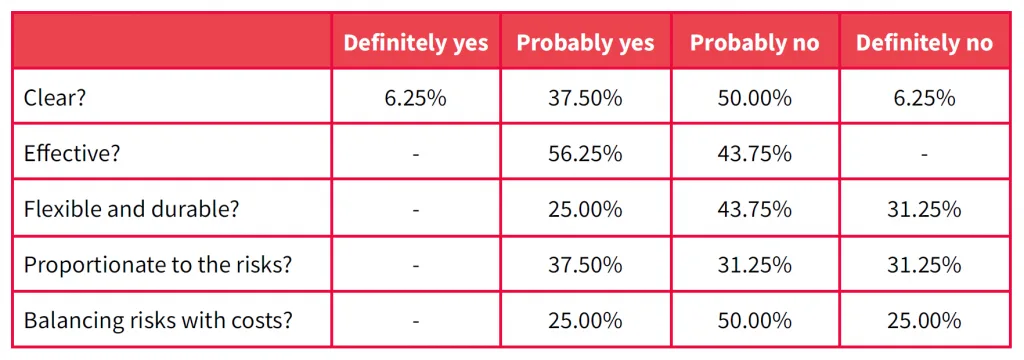
27. When asked whether the work health and safety regulatory system is clear, effective, flexible and durable, proportionate to the risks and balancing risks with costs, the following responses were received:
28. When asked if there was any other feedback about our members experience with the health and safety system that they wanted to share, selected comments include:
“Health and safety in New Zealand adds a high and unnecessary level of burden and cost on employers and is mostly to satisfy those hungry for bureaucracy.”
“It’s such a vast area now for businesses to understand. We previously paid for health and safety advice/compliance assistance but found it really expensive. The tools and downloads were pretty good, but overly complicated. There was also not enough focus on what we were doing well.”
“I think sector requirements would be really helpful as a starting point so everyone can then focus on extraordinary risks in their individual outlet rather than every little minor issue.”
Conclusion
Thank you for the opportunity to provide feedback on the Work Health and Safety regulatory system. Should you require any further information, or have any other questions, we would be happy to assist with coordinating a meeting between the Ministry and a key group of our members (for example, our Employment Relations Industry Advisory Group).
About the Association
The mission of the Restaurant Association of New Zealand is to be the link between good food and good business so that our Member’s restaurant or café can succeed. We’re passionate about our vibrant industry, which is full of interesting, talented and entrepreneurial people.
Since 1972, the Association has worked to offer advice, help and assistance in every facet of the vibrant and diverse hospitality industry. We are the representative body for more than 2,500 hospitality businesses, with Members covering the length and breadth of the country.